Your REST API, ready for every AI agent.
Connector Foundry converts the API you already have into a tested, reliable agent connector. Bring an OpenAPI spec — or just a docs URL. We propose the tools, prove them in a sandbox eval, and ship only what you approve.
DEMO WALKTHROUGH — GITHUB REST API
612 operations ingested · 8 tools proposed · 12-scenario eval harness · signed v3 release candidate
From your REST API to a signed agent connector, in seven gates.
Every stage is a checkpoint, not a black box. The service proposes — you review and approve. Nothing reaches an agent without your sign-off.
Import
OpenAPI 3.x is preferred, but not required. Drop in Swagger 2.0, a Postman collection — or just a docs URL with sandbox access, and we probe the API to infer the spec. Import findings surface immediately: recursive schemas, undocumented error codes, scope gaps.
Normalize
Everything compiles into a platform-neutral tool model — effects (read / write / destructive), idempotency, auth schemes, error mappings. Your connector is designed once, against no single platform's quirks.
Propose
The tool compiler drafts agent-ready tools with plain-language intents, input schemas, parameter bindings, retry policies, and recovery mappings. Destructive operations are flagged for your decision — never smuggled into the connector.
get_repository · create_issue · merge_pull_request
destructive ops require ALWAYS-confirm
Review
Ambiguities land in a decision queue with evidence, impact, and a recommendation — not a config file. Should merging a PR require confirmation? What does "merge it" mean with no PR number? You decide; the connector records it.
Evaluate
An automated harness runs your connector against a frozen sandbox: tool selection, argument handling, safety gates, execution, and recovery. Failures become review questions with traces — never silent auto-patches.
Publish
The release manager freezes a versioned, signed bundle — OpenAPI facade, MCP server bundle, and the Muse connector adapter — ready for Meta's submission pipeline. A release checklist gates every publish: blockers resolved, eval green, approvals complete.
Operate
Data-plane telemetry keeps watch after launch: traffic, errors, latency, prompt→tool attribution, and drift alerts when your API changes. Suggested fixes route straight back into curation — the connector improves instead of rotting.
See it running on a real API.
These are actual snapshots of the customer console, running on mocked data from the GitHub REST API walkthrough — 612 operations in, a signed v3 connector candidate out. Click through the seven screens.
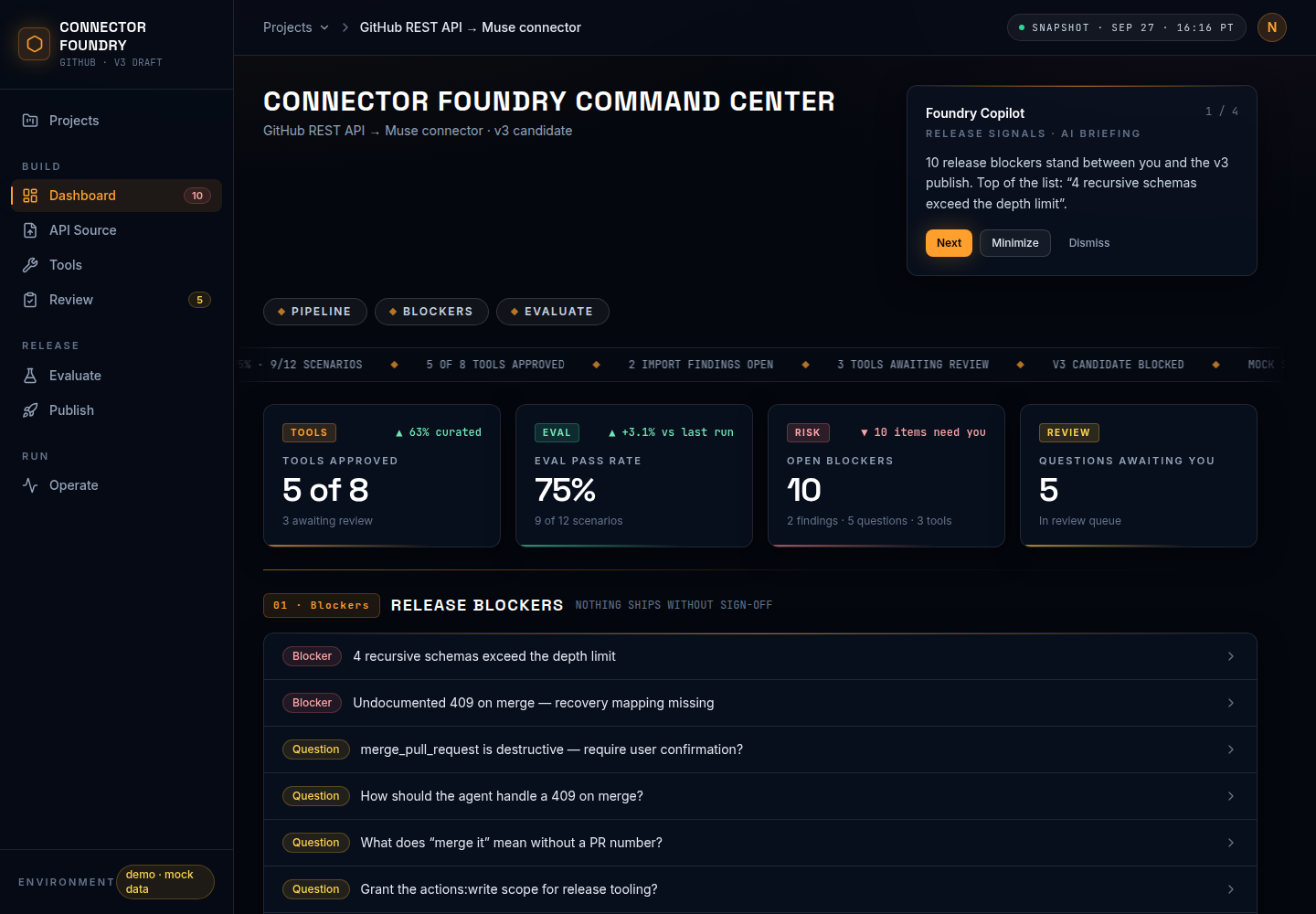
Command center
One screen answers "can we ship?" — pipeline KPIs, the next blocking step, and every open blocker with its owner.
- 5 of 8 tools approved, 3 awaiting your review — the pipeline never moves without you.
- 75% eval pass rate (9 of 12 scenarios) — every failure links to its trace and fix.
- 10 open blockers enumerated: 2 findings, 5 questions, 3 tools — "nothing ships without sign-off."
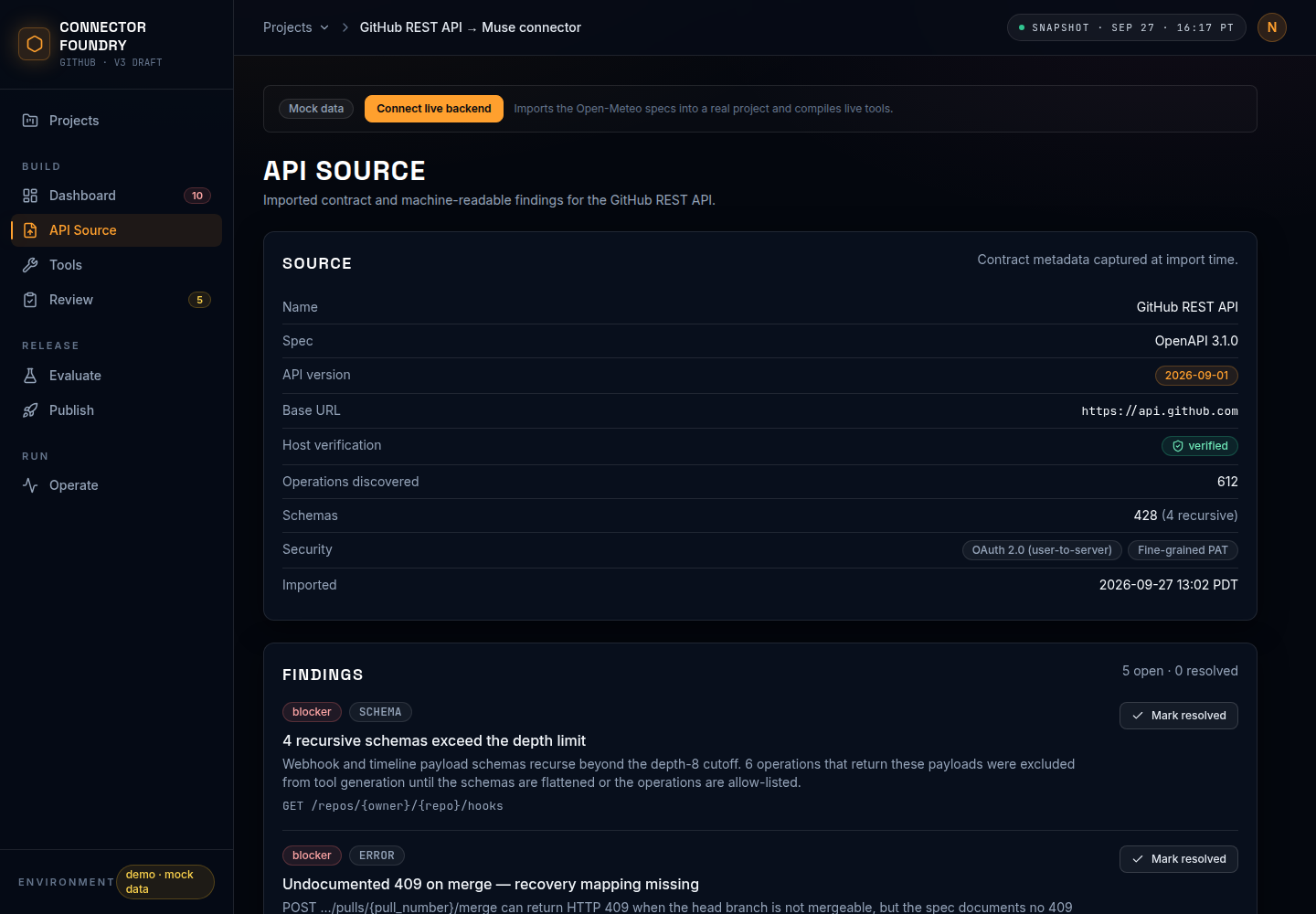
Bring what you have
Submit an OpenAPI spec, Swagger, Postman collection — or a docs URL. The importer inventories every operation and flags what needs your attention before a single tool is drafted.
- GitHub REST API: OpenAPI 3.1.0, 612 operations, 428 schemas, host verified.
- Blockers caught early: 4 recursive schemas over the depth limit, an undocumented 409 on merge.
- Warnings with teeth: 9 POSTs lack idempotency docs, 2 ops need scopes beyond the OAuth grant.
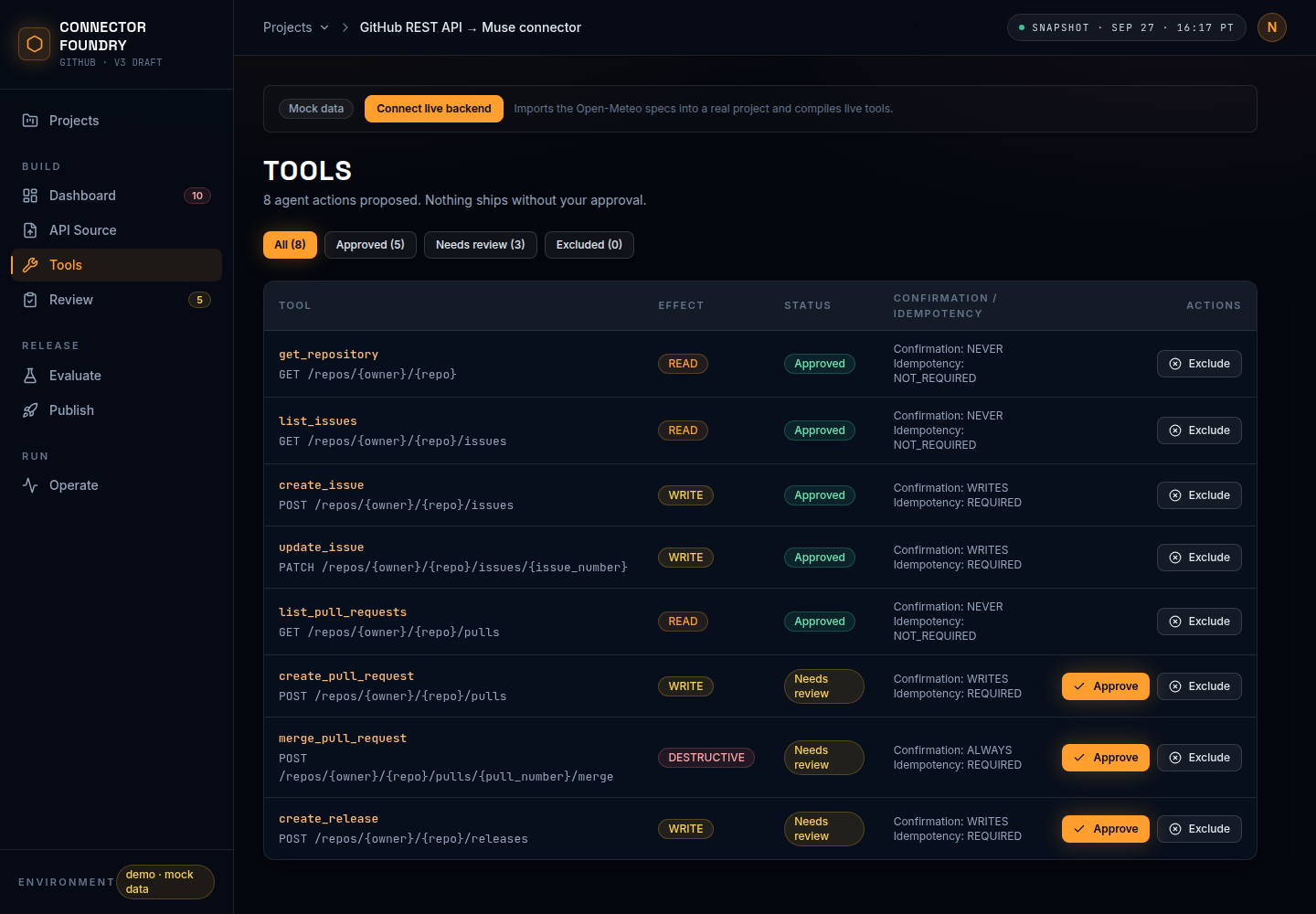
Curate the toolset
Every proposed tool shows its intent, effect, confirmation policy, and error recovery. You include, edit, or exclude — destructive operations are fenced, never hidden.
merge_pull_requestis tagged DESTRUCTIVE with ALWAYS-confirm — v3 made it stricter than v2.DELETE /repos/{owner}/{repo}is excluded outright: "irreversible admin action — outside agent scope."- Each tool carries retry policy + error mappings: 409 → don't retry, check mergeable state, escalate.
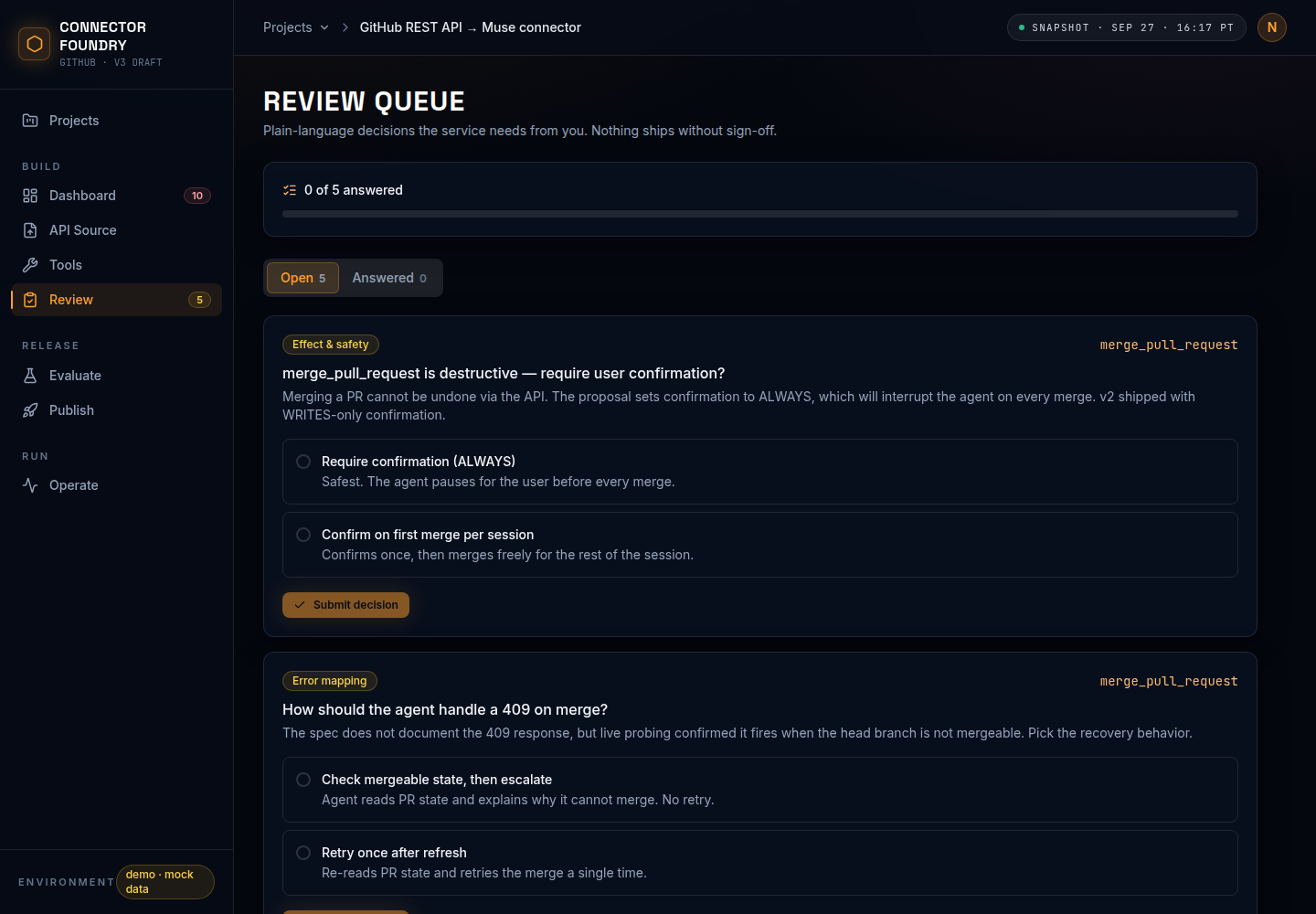
Decide with evidence
Where the spec is ambiguous or the eval found a gap, you get a question — with evidence, impact, and a recommendation. Pick an option; the connector records your decision.
- "What does 'merge it' mean with no PR number?" — the eval caught the agent guessing PR #482.
- "How should the agent handle a 409 on merge?" — live probing confirmed the undocumented response.
- Auth and scope decisions too: grant actions:write, or keep release tooling scoped down?
Proof, not promises
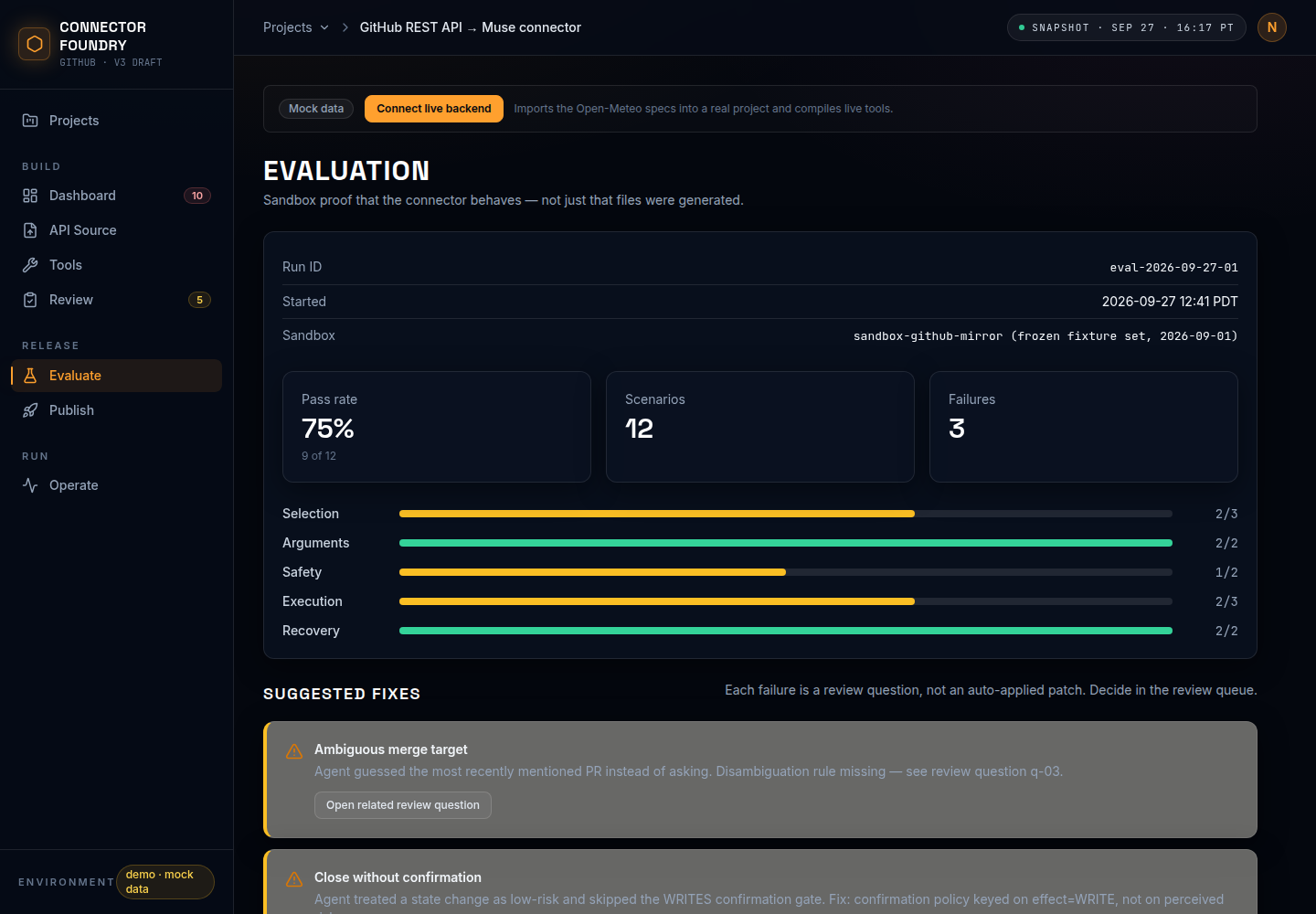
The harness runs your connector against a frozen sandbox and scores five dimensions. Failures ship with millisecond traces and a proposed fix — routed to your review queue, never auto-applied.
- Run eval-2026-09-27-01: 9/12 pass — selection 2/3, arguments 2/2, safety 1/2, execution 2/3, recovery 2/2.
- "Close without confirmation": the agent skipped the WRITES gate — fix keys confirmation to effect, not vibes.
- "Retry storm on 500": 4 retries, duplicate drafts — fix consults the dedupe cache before every retry.
Ship with a signature
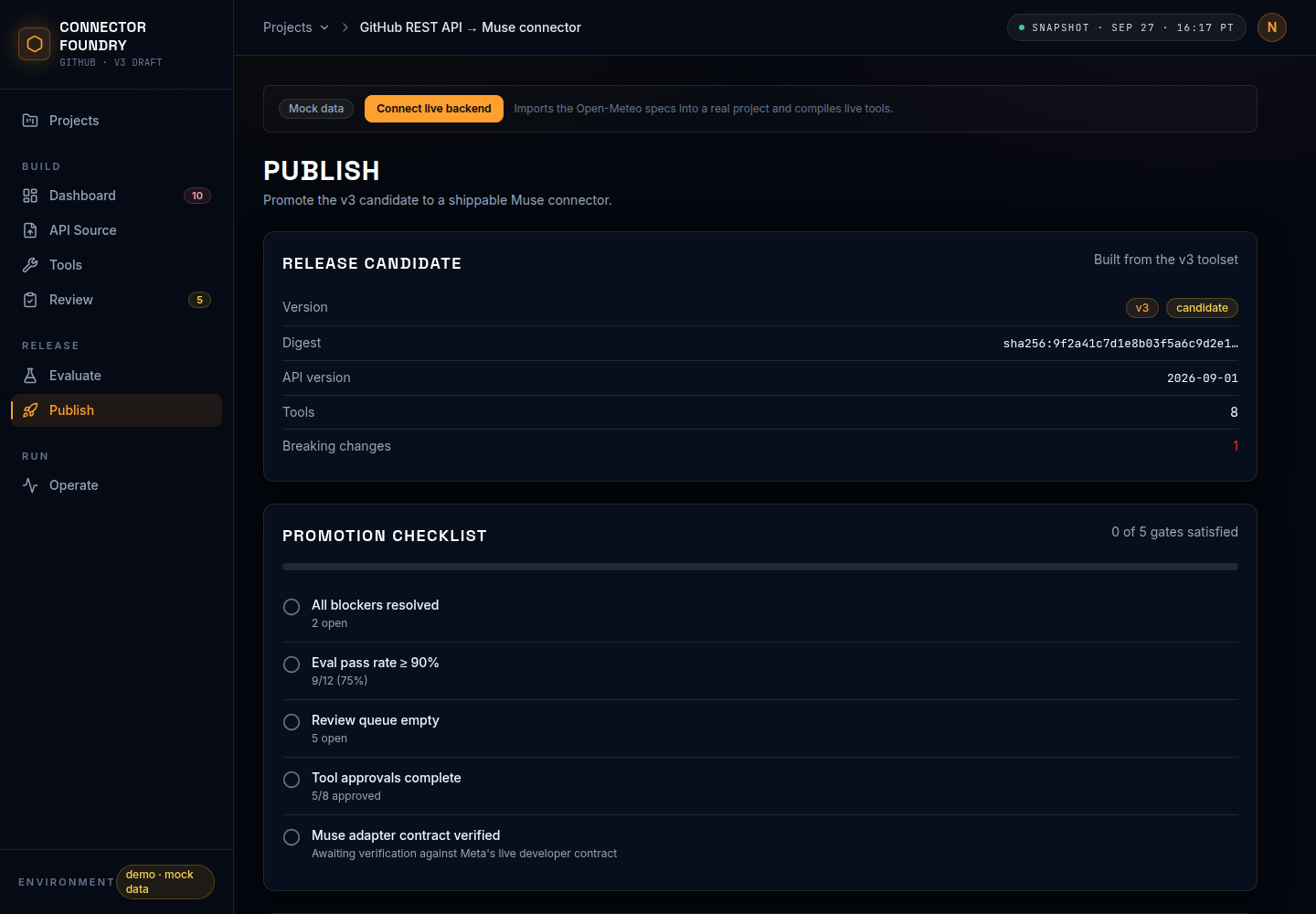
A release checklist gates every publish — blockers resolved, eval green, review queue empty, approvals complete, adapter contract verified. Then the bundle is frozen and signed.
- Release v3 candidate: 8 tools, 1 breaking change, sha256 digest — immutable once signed.
- Three targets from one review: OpenAPI facade, MCP server bundle, Muse connector adapter.
- The checklist is honest: 5/8 approvals, eval at 75% — this candidate is blocked, and it says so.
Watch it behave
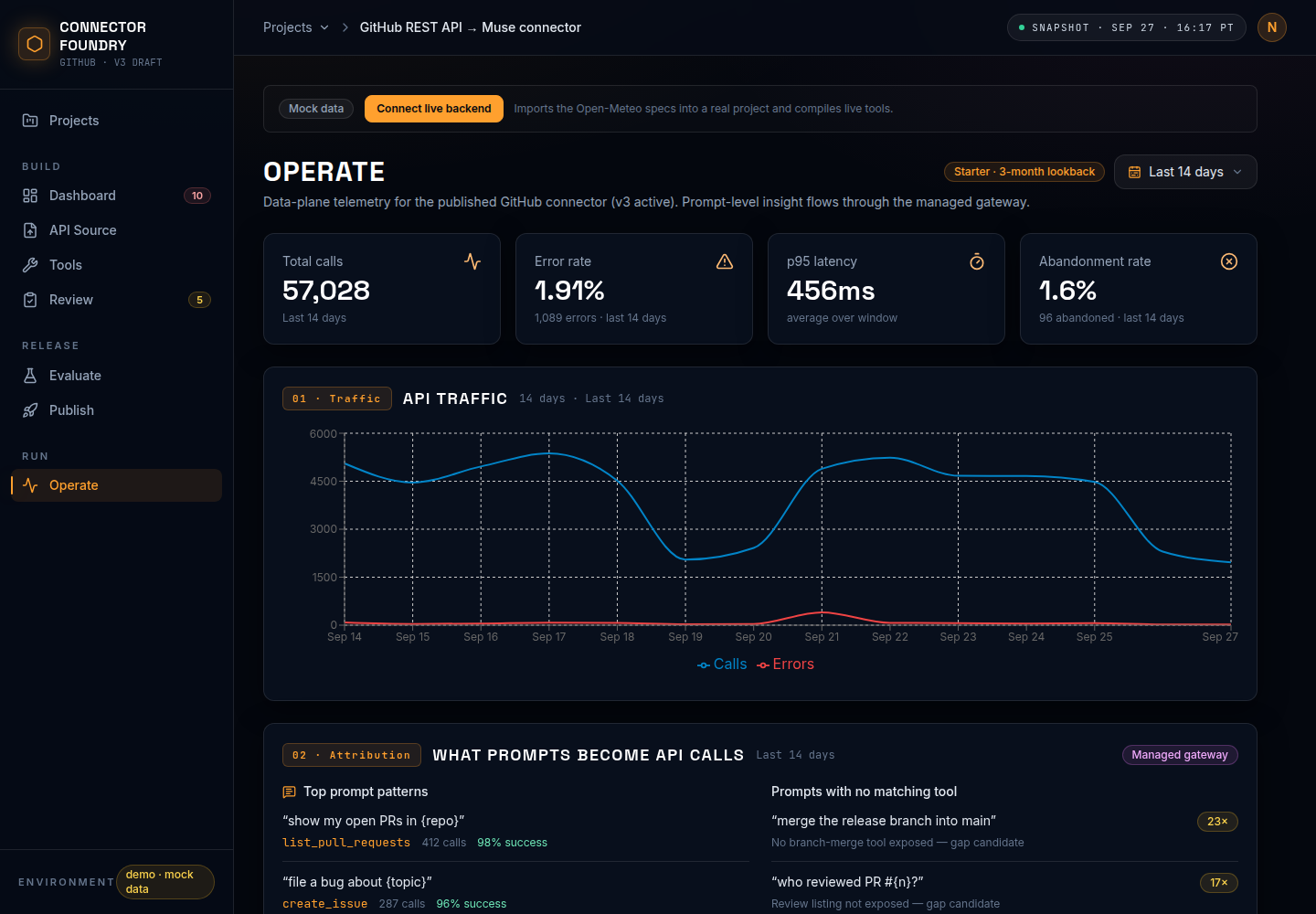
After launch, the data plane reports what agents actually do with your API — which prompts become which calls, where they fail, and what your API changes break.
- 57,028 calls in 14 days, 1.91% errors, 456ms p95 — with prompt→tool attribution per call.
- Unmapped prompts are gap candidates: "merge the release branch into main" ×23 → propose a new tool.
- Drift alerts: 4 new endpoints in the 2026-10-01 draft, a deprecated preview header — re-import before v4.
Snapshots show mocked demo data from the GitHub REST API walkthrough — the console ships with this demo project so you can evaluate the workflow before connecting your own API.
Conversion is commoditized. Trust isn't.
Turning an OpenAPI spec into an MCP server is a solved problem — open-source CLIs do it, and platforms are absorbing it. We don't compete on conversion. We compete on the trust infrastructure around it: proof it works, auth your security team will sign, and an approval trail that survives procurement.
Eval harness, not a playground
No competitor offers an automated reliability certification for API owners: sandboxed scenarios across selection, arguments, safety, execution, and recovery — with traces, gates, and version-gated releases. Manual playgrounds don't count.
Spec inference from a docs URL
Every vendor we surveyed requires a clean spec upload. Point us at your docs or sandbox and we probe and infer the spec — then show you exactly what we found before anything is generated.
Propose → review → approve → publish
No formal human-approval pipeline exists anywhere else in this market. The service proposes; you dispose. Every tool, error mapping, and confirmation policy waits for explicit sign-off — nothing ships silently.
| Capability | Connector Foundry | Spec→MCP generators Gram · Scalar · Zuplo · OSS CLIs |
Integration platforms Composio · Arcade · Nango |
Platform-native intake Meta · Anthropic · AWS |
|---|---|---|---|---|
| Spec inference from docs URL / sandbox probe | ✓ Yes — probe & infer, then show our work | ✗ Clean spec upload required | ✗ Prebuilt integrations only | ✗ "Raw API + optional OpenAPI," you do the work |
| Automated reliability eval & certification | ✓ Yes — sandboxed harness, 5 dimensions, gates | ~ Manual playgrounds, no harness | ✗ Evals serve agent builders, not API owners | ~ Opaque gatekept testing on submission |
| Propose → review → approve → publish | ✓ Yes — formal approval pipeline, auditable | ~ Partial — PR previews, no approval gate | ✗ Scoped access controls only | ✗ Their review, not yours |
| Platform-neutral canonical core | ✓ Yes — design once, adapters per platform | ✗ Single artifact, usually MCP | ✗ MCP-focused tool calling | ✗ Their platform only |
| API-key → per-user OAuth auth bridge | ✓ Yes — credential broker, secrets never in artifacts | ~ Bundled in their hosted runtime | ✓ Yes — but built for agent builders | ~ Their platform's auth plumbing |
| Built for API owners without AI teams | ✓ Yes — managed, trust-first service | ~ Self-serve dashboards | ✗ Agent-builder customer | ~ Self-serve intake forms |
The underserved middle.
Mid-market SaaS, this is your lane.
You want to be agent-ready — your customers are asking for it — but you don't have an AI team to build and babysit connectors.
Enterprise has gateways and six-figure platform deals. The low end has free tiers racing to zero. Nobody serves the middle with a managed, trust-first service priced below enterprise deals. That's us.
- You own a REST API with real customers.CRM, billing, devtools, support, logistics — if agents should act on it, we make it safe.
- Your security team has opinions.Per-user OAuth, vaulted secrets, redacted telemetry, auditable approvals — built for their checklist.
- Not for you if…you're an agent builder shopping for 1,500 prebuilt integrations — that's Composio/Arcade territory, and they're good at it.
Simple tiers, buyer-friendly metering.
Priced on telemetry lookback and project count — not per tool call. Early-access pricing is set at onboarding; these are the packaging levers.
Starter
Your first connector, end to end.
- 5 API projects
- 3-month telemetry lookback
- Full pipeline: import → eval → publish → operate
- Eval harness & approval workflow included
- Muse connector adapter
Growth
A portfolio of agent-ready APIs.
- 25 API projects
- 6-month telemetry lookback
- Everything in Starter
- Drift monitoring across all projects
- Priority eval queue
Scale
Agent-ready as a platform strategy.
- Unlimited API projects
- 12-month telemetry lookback
- Everything in Growth
- Multi-platform adapters as they ship
- Dedicated support & onboarding
Seats, support tier, and eval depth are set at onboarding · Lookback windows beyond your plan show as locked with the required tier named
Straight answers.
Be agent-ready before your customers ask twice.
Join the early-access list. We'll walk your API through the full pipeline — import to signed release — on a demo project first, so you see the workflow before you commit.
- Free guided walkthrough of your API (docs URL is enough)
- Eval report on your connector candidate — keep it either way
- Locked early-access pricing when we launch tiers